Who Makes the iPhone Camera? LG Innotek, Sharp and Other Camera Module Suppliers
Short answer: Apple designs the camera, Sony makes the image sensors (Apple has confirmed this publicly), and the finished modules are assembled mainly by LG Innotek, with Cowell and Foxconn as secondary suppliers and Sharp on older models. The module maker in your own iPhone can be read from each camera's module serial in a sysdiagnose. Settings never shows it.
Who makes the iPhone camera: the short answer
- Apple designs the camera system, the image signal processing inside its chips, and the software (Photonic Engine, Portrait mode, and so on). Apple’s name is the only one in Settings.
- Sony makes the image sensors. Apple rarely names suppliers, but in December 2022 Tim Cook publicly said Apple had been partnering with Sony “for over a decade to create the world’s leading camera sensors for iPhone” (The Verge).
- LG Innotek is the largest assembler of finished camera modules, according to Korean industry reporting, with Cowell, Foxconn, and historically Sharp as the other module makers named most often.
- Lens and actuator makers such as Largan, Genius, Alps, and Luxshare appear in analyst supply-chain notes for specific generations.
The four layers of an iPhone camera
Most people asking "who makes it" mean the company that assembled the finished module. There are four layers:
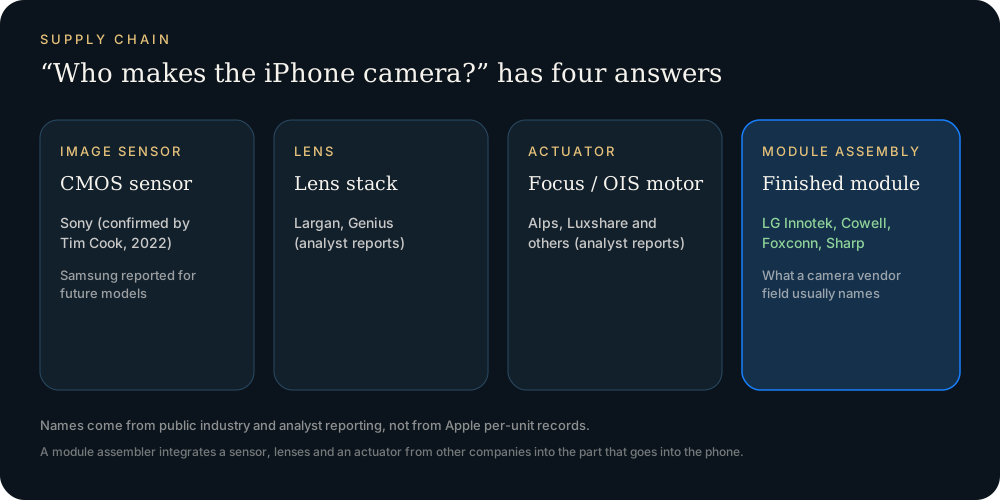
- Image sensor (CMOS) — the chip that turns light into data. Sony is the supplier Apple has confirmed.
- Lens stack — the stacked plastic and glass elements. Analyst Ming-Chi Kuo’s notes on the iPhone 14 front camera, for example, named Genius and Largan as lens suppliers (MacDailyNews summary of Kuo’s note).
- Actuator — the voice coil motor that moves the lens for autofocus and, on many models, optical image stabilization. The same Kuo note named Alps and Luxshare ICT for that front-camera generation.
- Module assembly — integrating the sensor, lenses, actuator, and flex cable into a calibrated module. This is where LG Innotek, Cowell, Foxconn, and Sharp come in. The same note listed LG Innotek and Cowell as the iPhone 14 front camera module makers.
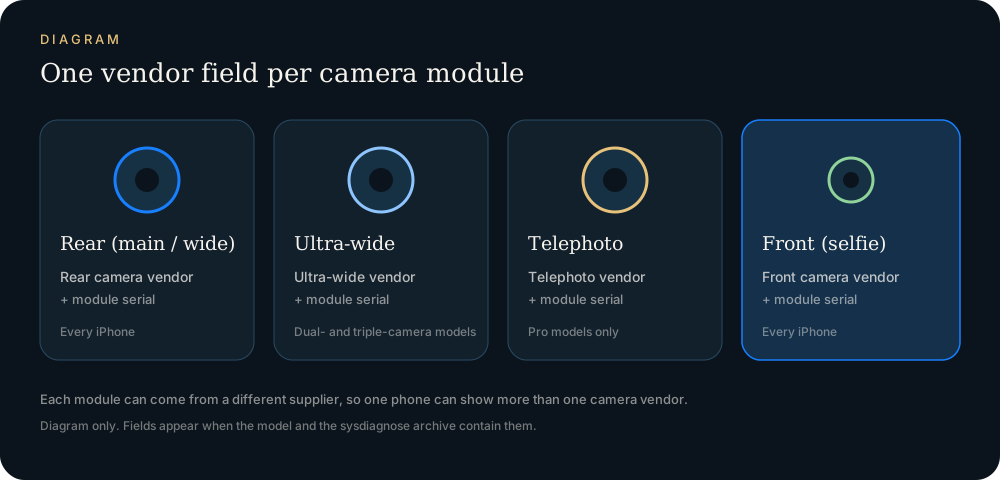
Each iPhone has several modules: a main (wide) rear camera, an ultra-wide on dual- and triple-camera models, a telephoto on Pro models, and a front camera. They do not have to come from the same assembler, which is why a single phone can report different vendors for different cameras.
Camera module suppliers: LG Innotek, Cowell, Foxconn and Sharp
Everything in this section is public industry reporting. Apple does not publish which supplier built which unit, and allocations shift from year to year.
LG Innotek
LG Innotek, part of South Korea’s LG Group, is consistently reported as Apple’s dominant camera module supplier. In early 2024 KED Global reported that LG accounted for about 70% of Apple’s camera module supplies, up from 65% in 2022 (KED Global). LG Innotek does not name its biggest customer, but its filings show a single customer making up most of its sales: Businesskorea reported that customer, presumed to be Apple, accounted for 77% of LG Innotek’s 2022 sales and that LG Innotek was the exclusive supplier of the folded zoom (tetraprism) module for the iPhone 15 generation (Businesskorea). In August 2026 Yonhap reported that sales to that single customer hit a first-half record of 8.84 trillion won (Yonhap).
LG Innotek is the name you are most likely to see for rear and telephoto modules, especially on Pro models.
Cowell (Cowell e Holdings)
Cowell is a Hong Kong-listed camera module maker. Coverage of its 2014 IPO noted that Apple had been a customer since 2009 and accounted for most of its turnover at the time (AVCJ). Industry reporting describes Cowell as mainly a front camera supplier, with ambitions to win more rear camera work (TheElec). If your lookup reports Cowell, it is most often on the front (selfie) camera.
Foxconn
Foxconn is best known for assembling whole iPhones, but it also builds camera modules. TheElec put its share of Apple’s camera module supply at around 10% when it reported on the iPhone 16 supplier lineup (TheElec).
Sharp
Sharp was long described as Apple’s second-largest camera module supplier after LG Innotek. In 2020, DigiTimes-sourced reports said Sharp and O-Film would share camera module orders for the lower-end iPhone 12 models while LG handled the Pro models (MacRumors). Later, TheElec reported that Sharp was not part of the iPhone 16 camera module development project, leaving LG Innotek, Foxconn, and Cowell as the three main module suppliers (TheElec). So a Sharp module is more plausible on older models than on recent ones.
Why one phone can have several vendors
Apple dual-sources most parts to protect supply and pricing. That means two iPhones of the same model, bought on the same day, can carry rear modules from different assemblers, and the front camera on either one may come from yet another company. None of these combinations is a defect, and none of them shows up in Settings.
Image sensors: Sony, and where Samsung fits
People searching iphone camera manufacturer samsung are usually mixing up layers. Samsung Display is a major iPhone screen supplier (see iPhone Display Suppliers by Model), but Samsung is not among the camera module assemblers named in the supply-chain reporting cited in this guide.
On the sensor side, Sony has been the supplier Apple confirmed. That may be changing. In August 2025 Apple announced it was working with Samsung at its fab in Austin, Texas, “to launch an innovative new technology for making chips, which has never been used before anywhere in the world” for Apple products including iPhone (Apple Newsroom). Apple did not say what kind of chip. The Financial Times, as summarized by The Verge, and later TheElec reported that it refers to stacked CMOS image sensors for future iPhones. Treat that as reporting about future models, not a statement about any phone you own today.
The sensor maker is also not something a configuration lookup shows. The camera fields described below identify the module supplier.
What Apple Settings tells you about your camera
Apple gives you one official camera check, and it answers a different question: was the camera replaced, and was the replacement genuine?
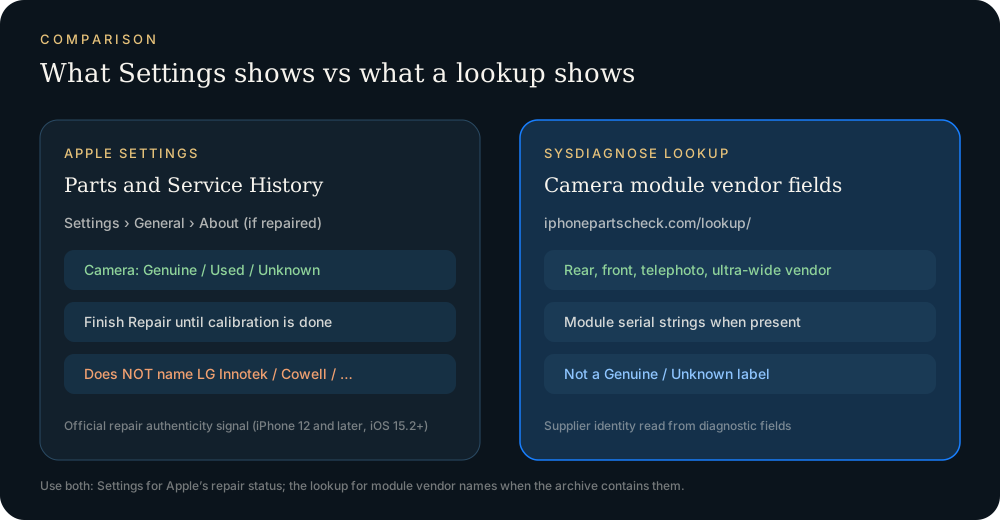
According to Apple’s About genuine iPhone cameras and iPhone Parts and Service History:
- On iPhone 12 models and later with iOS 15.2 or later, go to Settings → General → About. If the phone has been repaired, a Parts and Service History section appears. Apple lists Front camera and Rear cameras among the parts it reports for those models.
- Genuine means the repair used genuine Apple parts and processes.
- Used appears on iPhone 15 models and later with iOS 18 and later if the camera was already used or installed in another iPhone.
- Finish Repair appears after a new genuine camera is installed until the repair is completed with Repair Assistant. Apple notes that on iPhone 18 Pro models the camera cannot be used until the repair is finished or the iPhone is restored.
- Unknown appears if the installation is incomplete or the camera is not genuine, is not working as expected, has not been verified and linked after repair, or has been modified. Apple says this does not stop you using the camera but might affect trade-in value.
Apple also lists symptoms that can follow a nongenuine camera: focus problems, Portrait mode subjects out of focus, third-party camera apps freezing, or a blank preview. If there is no Parts and Service History section at all, Apple has no record of a repair on that phone.
What Settings does not do is name the module maker. You will never see “LG Innotek” or “Cowell” on the About screen. For the related battery and screen checks, see Original vs Aftermarket iPhone Battery and Is My iPhone Screen Original?.
How to see your own iPhone’s camera module vendor
iOS keeps a serial string for each camera module, and those strings are captured in a sysdiagnose archive, the diagnostic bundle you create with the volume and side button combination. The lookup tool on this site reads the rear, front, telephoto, and ultra-wide module serials from that archive and matches them against known supplier patterns to report a vendor for each camera.
The workflow:
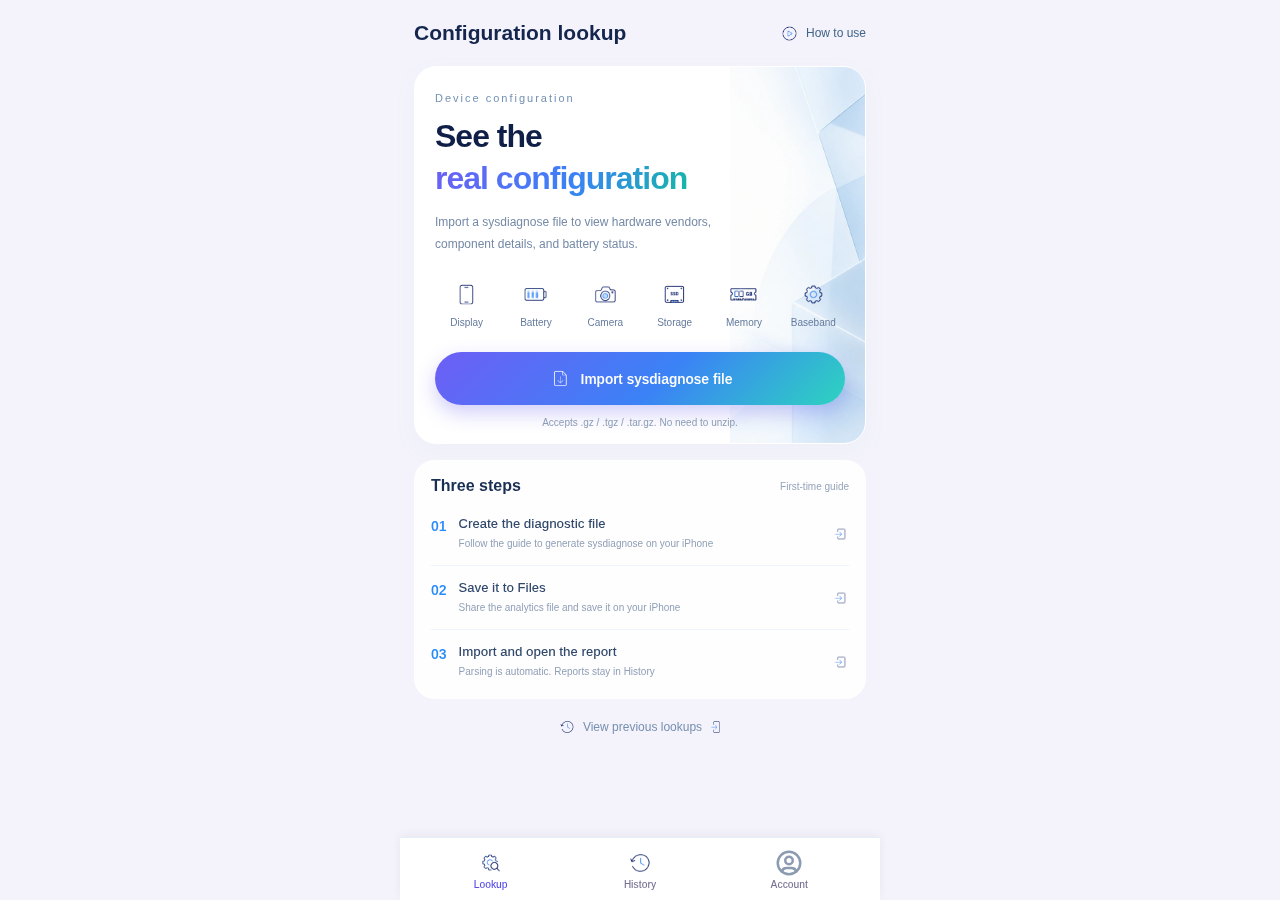
- Create a sysdiagnose on the iPhone. Full steps, including where to find the file under Analytics Data, are in How to Get a Sysdiagnose File on iPhone.
- Move the file (named
sysdiagnose_….tar.gz) to the device you will use for the lookup. You do not need to unzip it. - Import it at /lookup/ and open the Camera tab of the report.
- Read each row: Rear camera vendor, Front camera vendor, Telephoto vendor, and Ultra-wide vendor, each with its module serial. On a model without a telephoto or ultra-wide camera, those rows have nothing to report.
How the report decides the vendor. Each module serial starts with a supplier prefix. These are the rules our report uses:
| Camera | Serial field in the archive | Prefix → vendor used by our report | Grade |
|---|---|---|---|
| Rear (main) | BackCameraModuleSerialNumString |
DN8, GCF → LG Innotek |
Top |
| Rear (main) | same | DNM → Cowell |
Mainstream |
| Front | FrontCameraModuleSerialNumString |
GCF → LG Innotek |
Top |
| Front | same | FOW → Foxconn |
Mainstream |
| Telephoto | telephoto module serial | DN8/GCF → LG, DNM → Cowell |
Shown, not scored |
Any other prefix is shown as-is and graded Standard. These prefixes come from comparing reports, not from Apple documentation, and new prefixes appear with new models.
Vendor names the report can show for cameras include LG (LG Innotek), Cowell, Foxconn, and Sharp. If a module’s serial does not match a known pattern, the report says Unknown for that camera. That is not proof the camera is fake: new models, unusual batches, and incomplete archives all produce unknowns. Compare it with Parts and Service History before drawing conclusions.
Upload a sysdiagnose file to see the rear, front, telephoto and ultra-wide module vendors your iPhone reports, alongside display, battery, storage and baseband details.
Open the lookup toolOn this site the archive is unpacked in your browser and only the extracted configuration fields are sent to build the report; the original archive is not uploaded in that flow. Lookups use a paid quota; check /lookup/ for current plans.
Using camera vendors when buying a used iPhone
Camera vendor data is most useful as a consistency check, not as a quality ranking:
- If Parts and Service History says the camera is Genuine, the vendor is simply whichever supplier built the replacement module.
- If Settings shows Unknown and the lookup also returns an unrecognized vendor for the same camera, that is a stronger hint the module was swapped for a non-Apple part.
- If a seller claims “all original, never opened,” ask for a screenshot of Settings → General → About first. A missing Parts and Service History section plus normal vendor results is consistent with a phone that has not been repaired.
For a full checklist across display, battery, and cameras, use the complete original-parts guide. For screens specifically, see How to Check Who Made Your iPhone Screen.
Does the camera supplier change image quality?
There is no public, controlled evidence that an LG Innotek module takes better photos than a Cowell or Foxconn module built to the same Apple specification. Apple qualifies each supplier against its own design and calibrates genuine parts at manufacture; its support pages describe genuine parts as being individually calibrated with data stored at the time of manufacture and retrieved to finish a repair (Apple).
What does affect image quality, according to Apple, is whether the camera is a genuine, properly calibrated part. Nongenuine modules can cause focus, Portrait mode, and third-party app problems, especially after iOS updates that add camera features (Apple). So if you only check one thing, check Genuine versus Unknown, and treat the vendor name as extra context.
FAQ
Who is the main iPhone camera manufacturer?
Apple designs the camera, Sony supplies the image sensors, and LG Innotek is reported to assemble the majority of finished camera modules, with Cowell, Foxconn, and historically Sharp also named. No single company makes the entire camera.
Does Samsung make iPhone cameras?
Samsung is not among the module assemblers named in the reporting cited here. Apple announced in 2025 that Samsung’s Austin, Texas fab will make a new kind of chip for iPhone, and several outlets reported those are image sensors for future models. Samsung Display does supply many iPhone screens.
Can I see my camera manufacturer in Settings?
No. Settings shows only whether a replaced camera is Genuine, Used, Unknown, or awaiting Finish Repair, on iPhone 12 and later with iOS 15.2 or later. It never names the module supplier.
Can I find the camera supplier from my serial number or IMEI?
No. Apple does not offer a public lookup that maps a device serial or IMEI to camera module suppliers. The module vendor comes from the camera module’s own serial, which appears in a sysdiagnose archive.
Why does my report show different vendors for the front and rear cameras?
Because they are separate modules that can come from different assemblers. Cowell, for example, is mostly reported as a front camera supplier, while LG Innotek is most often reported on rear and telephoto modules.
My lookup says “Unknown” for one camera. Was it replaced?
Not necessarily. An unrecognized serial pattern can come from a newer model, an uncommon batch, or an incomplete archive. Check Parts and Service History; if Apple also reports that camera as Unknown, a non-genuine replacement becomes much more likely.
Is one camera supplier better than another?
There is no public evidence of a quality difference between suppliers building to Apple’s specification. Genuine versus non-genuine matters far more than which approved supplier built the module.
Import a sysdiagnose file to see the display, battery, camera, storage, memory and baseband makers in one report. Lookups use a paid quota.
Open the lookup tool